

BroadbandSwitch.uk Updates Free Full Fibre Upgrade Guide as 13.9 Million UK Premises Have Yet to Take Up Full Fibre
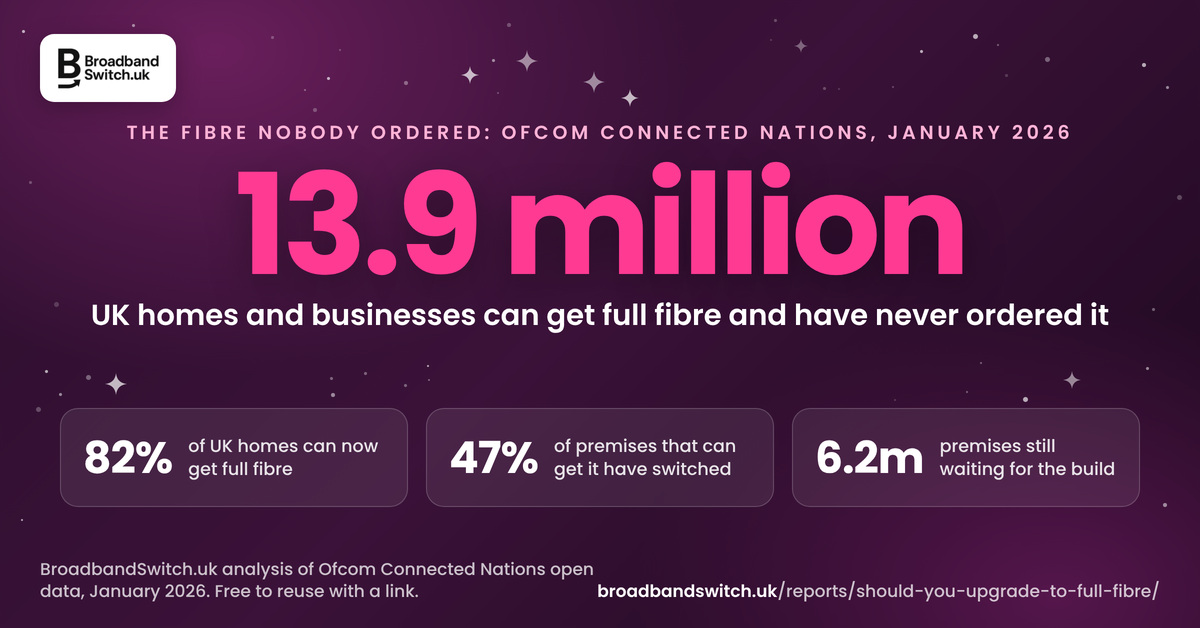
13.9 million UK homes and businesses can get full fibre and have never ordered it. 82% of homes can get it, 47% of those that can have switched. BroadbandSwitch.uk analysis of Ofcom Connected Nations data, January 2026

The two minute check: a router in the phone socket means copper is still in the line; a router in a small white box with a thin green lead means full fibre. A download well above 80 Mbps rules out part fibre. Image: BroadbandSwitch.uk
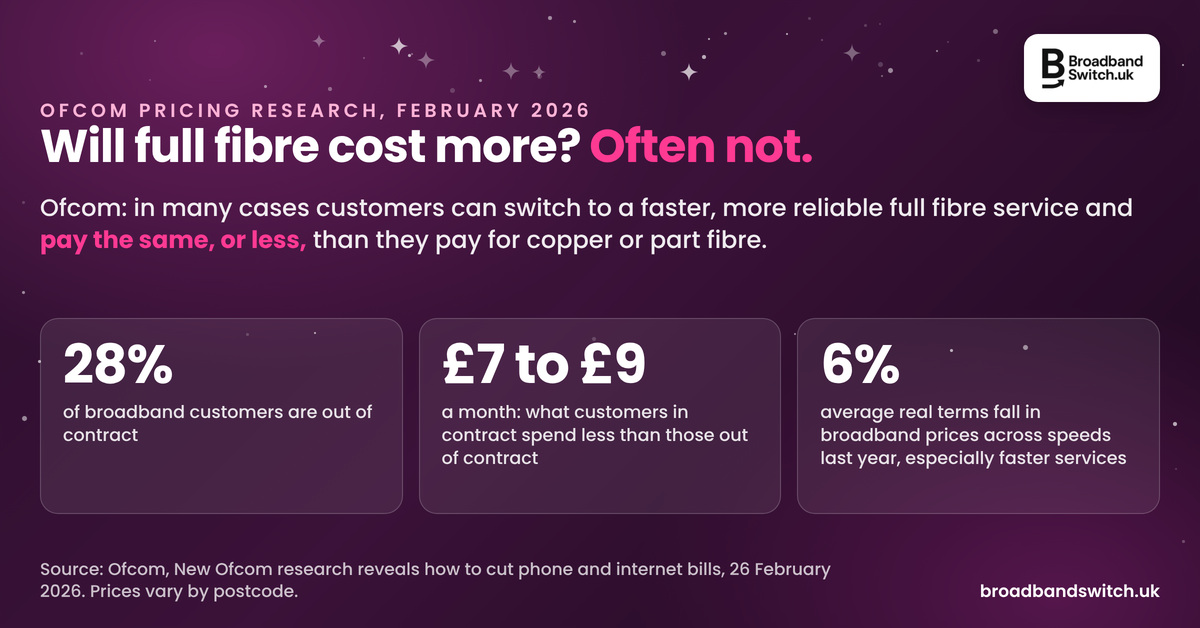
Ofcom found customers can switch to faster, more reliable full fibre and pay the same, or less, than for copper or part fibre. 28% are out of contract; in contract saves £7 to £9 a month. Ofcom, 26 February 2026
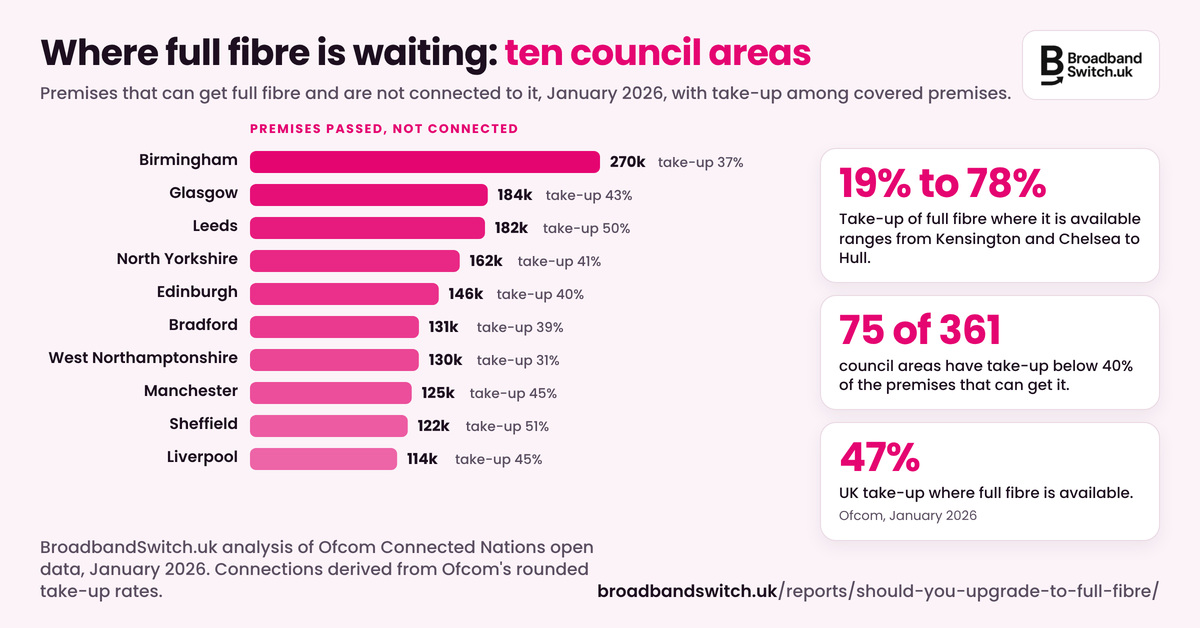
Where full fibre is waiting: Birmingham (270,000 premises passed, not connected), Glasgow, Leeds, North Yorkshire, Edinburgh, Bradford, West Northamptonshire, Manchester, Sheffield and Liverpool. BroadbandSwitch.uk analysis of Ofcom data, January 2026
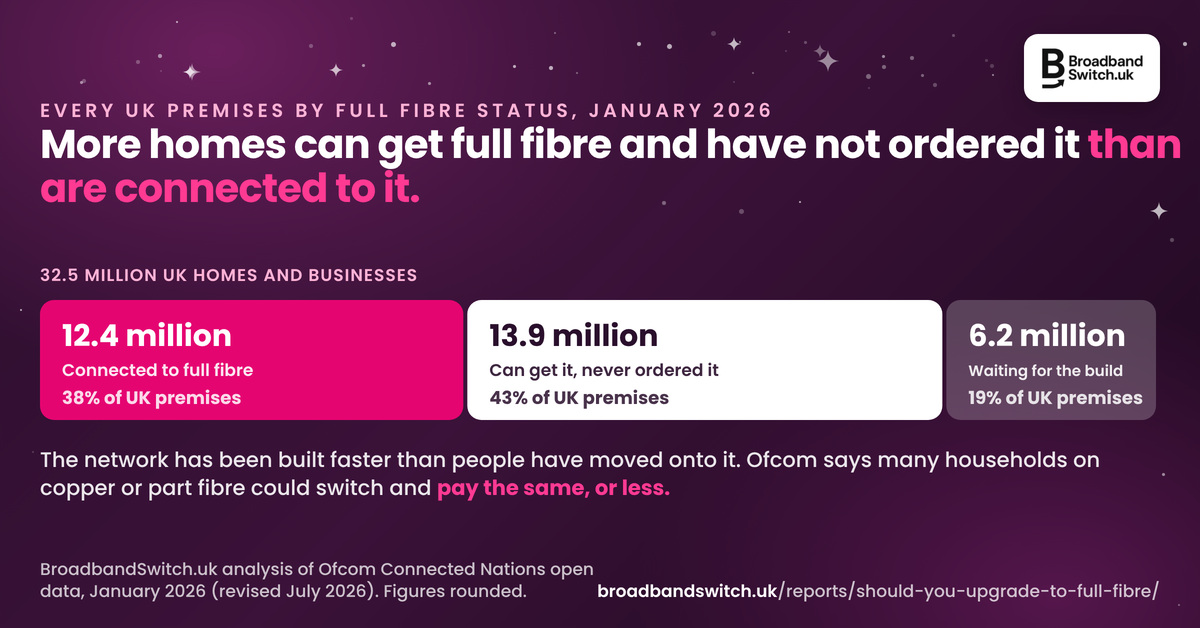
UK premises by full fibre status, January 2026: 12.4 million connected (38%), 13.9 million available and never ordered (43%), 6.2 million waiting for the build (19%). BroadbandSwitch.uk analysis of Ofcom open data
Ofcom data shows 82% of UK homes can get full fibre and 47% of premises with access have taken it up. By council area, take-up runs from 19% to 78%.
The timing is set by two deadlines and one price finding. The analogue landline network is being retired on 31 January 2027, now under four months away, and Ofcom's market data published today shows fixed voice lines fell by 522,000 in the second quarter of 2026 to 20.2 million. Openreach is retiring copper exchange by exchange, naming its latest batch on 8 October. And Ofcom's pricing research says that in many cases customers can switch to faster, more reliable full fibre and pay the same, or less, than they pay for copper or part fibre. Prices and availability vary by postcode, so the guide ends where every upgrade starts: with an address check.
Key facts
1. Full fibre was available to 24.9 million UK homes, 82% of the total, in January 2026, and 12.4 million premises were connected, 47% of all premises with access (Ofcom, Connected Nations update Spring 2026).
2. About 13.9 million premises had full fibre available and had not taken it up, and 6.2 million were still waiting for the build (BroadbandSwitch.uk analysis of Ofcom open data).
3. Take-up where full fibre is available ranges from 19% in Kensington and Chelsea to 78% in Hull, and 75 of the UK's 361 council areas are below 40% (Ofcom local authority data, January 2026).
4. Where full fibre has been available for a year or less, 14% of premises have taken it; where it has been available for three years or more, 55% have (Ofcom, Connected Nations 2025).
5. The analogue landline network is being retired on 31 January 2027, with around 1.2 million lines still to migrate in September 2026 (Openreach).
What is full fibre, and why does "fibre" on a bill not mean full fibre?
Full fibre means the fibre optic cable runs all the way into the home. Broadband that runs fibre to the street cabinet and copper for the last stretch has long been sold as "fibre"; Openreach's part fibre products top out at 76 Mbps download, with upload far lower, and Openreach says copper is vulnerable to weather damage. Since 16 September 2024, Ofcom has required providers to describe a service clearly before a customer agrees to buy, using terms such as full fibre, part fibre, cable or copper, and "fibre" on its own is no longer allowed.
How can a household tell in two minutes?
The check starts by following the cable from the router. If it runs into the telephone socket on the wall, copper is still in the line. If it runs into a small white box, usually with a thin green lead running into it, the home is already on full fibre. A home on cable broadband will see the router connected to a coaxial wall socket instead. The second clue is speed: Pulse, the free broadband speed test on BroadbandSwitch.uk, takes about thirty seconds, and a download well above 80 Mbps rules out part fibre. A lower result does not prove copper, because full fibre is also sold at lower speeds, so the wall box and the bill come first.
Where is the gap biggest?
BroadbandSwitch.uk's analysis of Ofcom's local authority data finds the largest numbers of premises passed but not connected in Birmingham (about 270,000, with take-up at 37% of covered premises), Glasgow (184,000, 43%), Leeds (182,000, 50%), North Yorkshire (162,000, 41%), Edinburgh (146,000, 40%), Bradford (131,000, 39%), West Northamptonshire (130,000, 31%), Manchester (125,000, 45%), Sheffield (122,000, 51%) and Liverpool (114,000, 45%). The city totals include homes that already have gigabit cable and areas where full fibre is new, which is why Leeds and Sheffield are already at the UK rate while Birmingham and West Northamptonshire have further to go.
The lowest take-up among areas with substantial coverage is in Kensington and Chelsea (19%), Blackpool and Oxford (both 22%); the highest is in Hull (78%), where the network is older, Ards and North Down (75%) and Mid and East Antrim (74%). Coverage itself is highest in Northern Ireland, where full fibre reaches 96% of homes, against 82% in England, 83% in Wales and 75% in Scotland.
Time explains much of the pattern. Ofcom's Connected Nations 2025 report found that where full fibre had been available for a year or less, only 14% of premises had taken it, rising to 55% where it had been available for three years or more, and that rural take-up, at 56%, was ahead of urban take-up at 40%. In July 2026 Ofcom described "around half of households that could access full-fibre broadband yet to sign up".
Why have 13.9 million premises not taken it up?
The guide sets out the six reasons heard most often and answers each: the connection works, so it never gets reviewed; the bill said "fibre", so people think they already have it; cable homes already have gigabit downloads, so the difference is upload speed and price; renters and people in flats expect to need permission, which is usually solved by asking early; worries about the landline, power cuts and telecare alarms, which have answers; and the belief that switching is hassle, when under One Touch Switch the customer contacts only the new provider, a process 3,431,195 people had started by 3 September 2026 and one the BroadbandSwitch.uk switching hub maps in nine steps, with a two minute video. Not all 13.9 million are on copper: some are on cable and some are businesses, but a large share are households on part fibre or copper.
Will full fibre cost more?
Often not. Ofcom's research, published on 26 February 2026, found that in many cases customers can switch to a faster, more reliable full fibre service and "pay the same, or less" than they pay for copper or part fibre. Across speeds, average broadband prices fell by 6% in real terms last year, especially for faster services. In-contract customers spend £7 to £9 a month less than out-of-contract customers, and 28% of broadband customers are out of contract. Prices vary by postcode, and so does the saving.
"The network has been built faster than people have moved onto it, and Ofcom's own data shows where," said Dr Alex J. Martin-Smith, founder of BroadbandSwitch.uk and author of the guide. "Most of the 13.9 million are not refusing full fibre. Their broadband works, they think they already have it, or they expect the switch to be a hassle, and each of those has a simple answer. The check takes two minutes. The bill tells you what you pay and the speed test tells you what you get, and for a lot of households the answer is that they could pay the same or less for a line that is many times faster."
What is copper stop-sell, and when does the landline switch off?
Stop-sell does not disconnect existing lines. It means Openreach copper products can no longer be ordered at addresses where Openreach full fibre is available, so a household that moves or signs a new contract there will be offered full fibre or another network's service; Openreach says customers who cannot yet get full fibre can keep their copper service until it arrives. Openreach gives providers a year's notice of each batch. By 20 August 2026 it had activated stop-sell in 1,572 exchanges covering around 15.4 million premises, and on 8 October 2026 it named a further 112 exchange areas covering more than 619,000 premises, taking the programme to 1,663 exchanges and around 16.4 million premises by November 2026.
The analogue landline network is a separate deadline. It is being retired on 31 January 2027, and home phones move to digital lines that run over broadband. Openreach said on 24 September 2026 that around 15 million lines had migrated, around 1.2 million remained, including around 350,000 business premises, and that a temporary emergency phone service will be used after the closure for eligible lines that have not migrated; the deadline is unchanged. Digital lines need power at home, so anyone who relies on a telecare alarm, or who needs to call 999 in a power cut, should tell the provider before booking and ask about a battery back-up.
What does this mean for renters, flats and new homes?
Renters normally need the landlord's permission for installation work, and in blocks of flats the building owner often has to agree network access first, so the advice is to ask early. New homes in England have had to be built with gigabit ready infrastructure since 26 December 2022, with a working gigabit capable connection where one can be installed for up to £2,000 per dwelling. For the 6.2 million premises still waiting, the £5 billion Project Gigabit had covered about 318,000 of 846,770 contracted premises by September 2026, and Ofcom says full fibre could reach 28.1 million homes, 92%, by January 2029 if every planned build goes ahead.
How does a household upgrade?
The guide's how-to runs to eight steps: check what the address can get; check what the home is on now; find the contract end date, because out of contract means no exit fees; work out the speed the household needs; compare, then ask the current provider to match; order from the new provider only, which under One Touch Switch manages the switch; plan the installation day, including where the router goes and any telecare alarm; then test the speed after a week. Many installations take a single engineer visit of a few hours. The guide is equally clear about when to wait: a person living alone on a good copper line still in contract, a household already on gigabit cable, or anyone early in a long contract with high exit fees.
"Switching to full fibre is not a leap any more," said Adrian James, broadband editor at BroadbandSwitch.uk, who reviewed the guide. "You order from the new provider and they usually arrange the rest, the installation is often a single visit, and you can usually keep your number. Moving on your own terms, at the end of your contract, is easier than being moved later when the copper goes."
Where is the guide?
The full fibre broadband upgrade guide is free on BroadbandSwitch.uk, with the two minute check, three diagrams, the eight step how-to, and a five question "is it worth it for me" checker. Every upgrade starts with an address: consumers can check which full fibre broadband deals are available at a postcode, see which providers reach the exact address and what each charges, and let the new provider do the rest.
What happens to the landline?
The customer can usually keep the number. The phone moves to a digital line that runs over broadband, with the handset plugged into the router or an adapter. Digital lines need power at home, so anyone who needs to call 999 in a power cut should ask the provider about a battery back-up before switching.
About BroadbandSwitch.uk
BroadbandSwitch.uk is an independent UK broadband comparison service, part of the SearchSwitchSave group. It earns a commission when a customer orders through its comparison, which does not change the price the customer pays. Deals are listed by monthly cost, lowest first, and commission never decides the order. Its guides and Data Lab reports are written by named authors and carry a public corrections log. Customer line: 0330 122 1223.
Notes to editors
1. Method. The figures are BroadbandSwitch.uk's analysis of the open data Ofcom published with its Connected Nations update: Spring 2026 (January 2026 snapshot, release r1, Open Government Licence). Ofcom's UK file gives 32,493,694 premises, 26,311,581 of them with full fibre available. Its local authority file gives take-up for 361 council areas as a share of all premises; connected premises are that rate multiplied by the premises count, and the UK sum, 12.4 million, matches Ofcom's published total. The 13.9 million is covered less connected, and the 6.2 million is not yet covered. Ofcom rounds its rates to whole percentages, so area figures are rounded to the nearest thousand. "Not taken up" means not connected in Ofcom's data, including empty premises.
2. The full local authority table, all 361 areas, is available to journalists on request and will be published on the guide page.
3. Ofcom's "pay the same, or less" finding compares full fibre packages with copper and part fibre services, and Ofcom's wording is "in many cases". The £7 to £9 figure is Ofcom's average monthly saving for customers in contract against those out of contract.
4. Free tools referred to in this release, all on BroadbandSwitch.uk: the upgrade guide itself, the One Touch Switch map and video on the switching hub, the Pulse speed test, the Fibre Gap Explorer, a council by council lookup, and the broadband speed calculator. Addresses for each are available from the contact below.
5. The five images with this release are free to reuse with a credit and a link to the guide. Dr Alex J. Martin-Smith and Adrian James are available for interview on 0330 122 1223.
References
Department for Culture, Media and Sport. (2023, January 30). New build connectivity: Information for developers. GOV.UK.
Department for Science, Innovation and Technology. (2026, September). September 2026: Premises contracted and built under Project Gigabit contracts. GOV.UK.
Fibre Provider. (2026, October 9). Openreach adds 112 areas to stop sell programme.
Ofcom. (2024, September 16). Customers to get clearer broadband information.
Ofcom. (2025, November 19). Connected Nations UK report 2025.
Ofcom. (2026, February 26). New Ofcom research reveals how to cut phone and internet bills.
Ofcom. (2026, February 26). Pricing and consumer engagement: Trends in the UK communications sector.
Ofcom. (2026, May 13). Connected Nations update: Spring 2026, with the fixed broadband coverage and full fibre take-up open data files.
Ofcom. (2026, May 13). Connected Nations: Planned network deployments 2026.
Ofcom. (2026, July 28). Ofcom proposes to block new Openreach commercial offer to protect fair competition and keep long-term prices low.
Ofcom. (2026, September 12). Around 3.5 million Brits hit switch amidst cost-of-living concerns.
Ofcom. (2026, October 14). Telecommunications market data update Q2 2026.
Openreach. (2023, July 24). FTTP vs FTTC: What does it all mean?
Openreach. (2026, July 27). Openreach puts a stop to copper for another half million premises in bid to push customers to new digital lines.
Openreach. (2026, September 24). Openreach to protect broadband connections as PSTN closure approaches.
Dr. Alex J. Martin-Smith CMgr DBA
Upleashed® Limited | Including BroadbandSwitch.uk
+44 3301221223
press@broadbandswitch.uk
Visit us on social media:
LinkedIn
Bluesky
Instagram
Facebook
YouTube
TikTok
X
Other
How to Switch Broadband in the UK in 9 Simple Steps: One Touch Switch Explained (Short)
Legal Disclaimer:
EIN Presswire provides this news content "as is" without warranty of any kind. We do not accept any responsibility or liability for the accuracy, content, images, videos, licenses, completeness, legality, or reliability of the information contained in this article. If you have any complaints or copyright issues related to this article, kindly contact the author above.
