

The Global Fencing Market Is Projected to Surpass $46 Billion by 2030 with a 5% CAGR
Fencing Market
Fencing Market analysis
Fencing Market analysis growth
The Business Research Company’s Fencing Global Market Report 2026 – Market Size, Trends, And Forecast 2026-2035
LONDON, GREATER LONDON, UNITED KINGDOM, October 16, 2026 /EINPresswire.com/ -- The fencing industry is undergoing significant development as demand grows for reliable, secure, and visually appealing boundary solutions. With rapid technological advances and shifting customer needs, the fencing market is evolving to offer more durable materials, integrated security features, and expanded service options. Below is an in-depth look at the market size, key growth drivers, major players, and emerging trends shaping this dynamic sector.
Current Market Size and Projected Growth in the Global Fencing Market
The global fencing market is forecast to exceed $46 billion by 2030, growing at a steady compound annual growth rate (CAGR) of 5%. Leading providers in access solutions, perimeter security, and specialized fencing compete by emphasizing advanced perimeter protection technologies, durable materials, modular designs, automation integration, and sustainable manufacturing practices. Their focus centers on delivering long-lasting performance, regulatory compliance, strong site protection, corrosion resistance, and adaptability for diverse applications ranging from residential to critical infrastructure.
Request A Free Sample Of The Fencing Market Report
https://thebusinessresearchcompany.com/sample_request?id=96447519&type=smp&name=Fencing%20Market%20Report%202026&utm_source=EINPresswire&utm_medium=Paid&utm_campaign=Oct_PR
How Strategic Acquisitions Are Transforming the Fencing Industry
Recent acquisitions are playing a pivotal role in reshaping the fencing market landscape, as companies expand their offerings, improve distribution reach, and enhance comprehensive outdoor living solutions. For instance, in June 2024, Master Halco Inc. acquired Forest Products Sales (FPS)/US Vinyl Fence, a US-based supplier specializing in fencing, decking, railing, and lumber products. This acquisition strengthened Master Halco’s presence in Utah and surrounding markets, broadened its product portfolio, and enhanced its capability to provide fully integrated fencing and outdoor structure solutions.
Materials Durability, Residential Demand, and Security Concerns Propel Market Growth
Several core factors are driving the fencing market’s rapid expansion through 2030. First, increasing consumer preference for durable and low-maintenance materials such as galvanized steel, aluminum, vinyl, and composites is boosting demand. These materials offer extended service life, corrosion resistance, and low upkeep, further enhanced by new coatings and treatments that prolong product longevity. This trend is estimated to add about 1.8% annual growth to the market.
Access The Detailed Fencing Market Report Here
https://thebusinessresearchcompany.com/report/fencing-global-market-report?utm_source=EINPresswire&utm_medium=Paid&utm_campaign=Oct_PR
Housing construction and remodeling projects also contribute significantly to market growth. New residential developments and home renovations create steady demand for fencing that ensures privacy, safety, and aesthetic appeal. Homeowners seek modern designs and clear property boundaries, while developers increasingly include fencing as a standard feature amid a rising interest in outdoor living spaces. This trend is expected to contribute approximately 1.5% annual growth.
Meanwhile, growing perimeter security requirements across industrial, transport, public infrastructure, and commercial sites are fueling demand for high-performance fencing. These systems often integrate surveillance, access control, and specialized features to meet stringent security standards. This factor is projected to add roughly 1.3% annual growth to the fencing market.
A Bright Outlook for Fencing Market Valuation and Industry Outlook
By 2030, the fencing market is projected to surpass $46 billion, accounting for nearly 0.5% of the larger Metal and Mineral industry, which itself is forecast to reach $9,886 billion. The steady 5% CAGR highlights ongoing investment in fencing solutions across sectors, driven by evolving security needs, material innovations, and infrastructure development.
Regional and Country Leaders in the Global Fencing Market
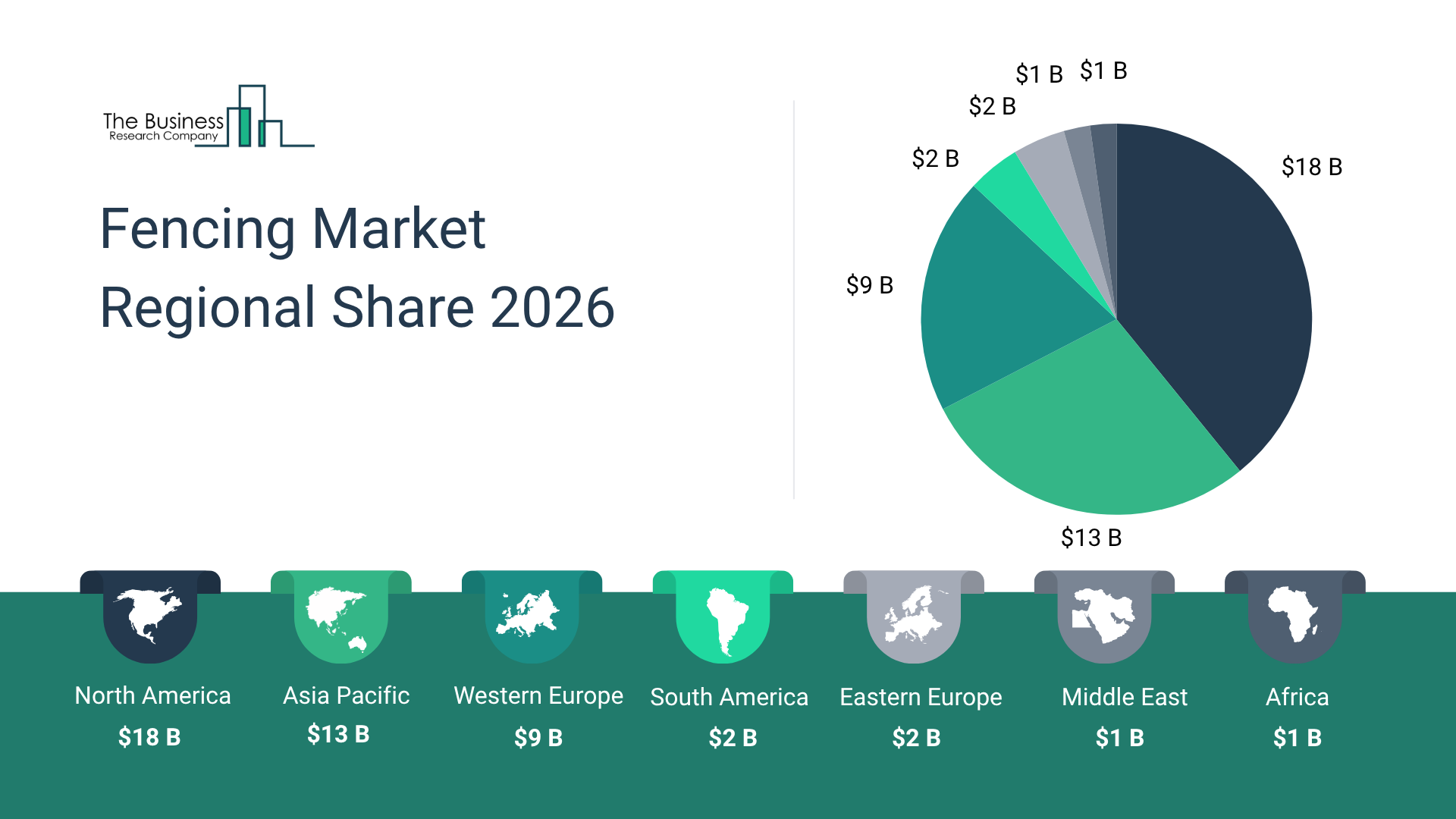
North America is set to remain the largest fencing market region in 2030, with an estimated value of $18.1 billion, up from $14.6 billion in 2025. The region’s growth at a 4% CAGR reflects continued investments in residential properties, enhanced perimeter security at industrial and commercial sites, infrastructure projects requiring boundary protection, and agricultural fencing modernization throughout the US and Canada.
Among countries, the United States will lead, with a market size forecasted at $14.7 billion in 2030, rising from $12.0 billion in 2025 at the same 4% CAGR. Drivers include home improvement projects, critical infrastructure security needs, suburban demand for privacy and decorative fencing, utility and energy sector site protection, and replacement of older fencing systems with advanced, weather-resistant options.
Material Preferences Point to Metal’s Dominance in the Fencing Market
When segmented by material, the fencing market includes plastic, metal, wood and composite, and concrete. Metal fencing is expected to hold the largest share in 2030, representing 48% or approximately $22 billion of the total market. Its dominance comes from its superior strength, durability, and suitability for high-security environments, particularly in industrial, transportation, and defense sectors. The demand for corrosion-resistant galvanized and coated metal systems, combined with preferences for long-lasting materials that reduce maintenance costs and innovations that improve structural performance and ease of installation, fuels metal’s leadership.
Additional Market Segmentation by Installation, Application, and End Use
The fencing market can also be categorized by installation type—do-it-yourself versus contractor-installed—and by application areas such as residential, agricultural, and industrial sectors. Furthermore, end uses include government, mining, defense, petrochemical, transport, and energy industries, demonstrating the broad scope and versatility of fencing solutions.
Market Leadership and Competitive Landscape in Fencing
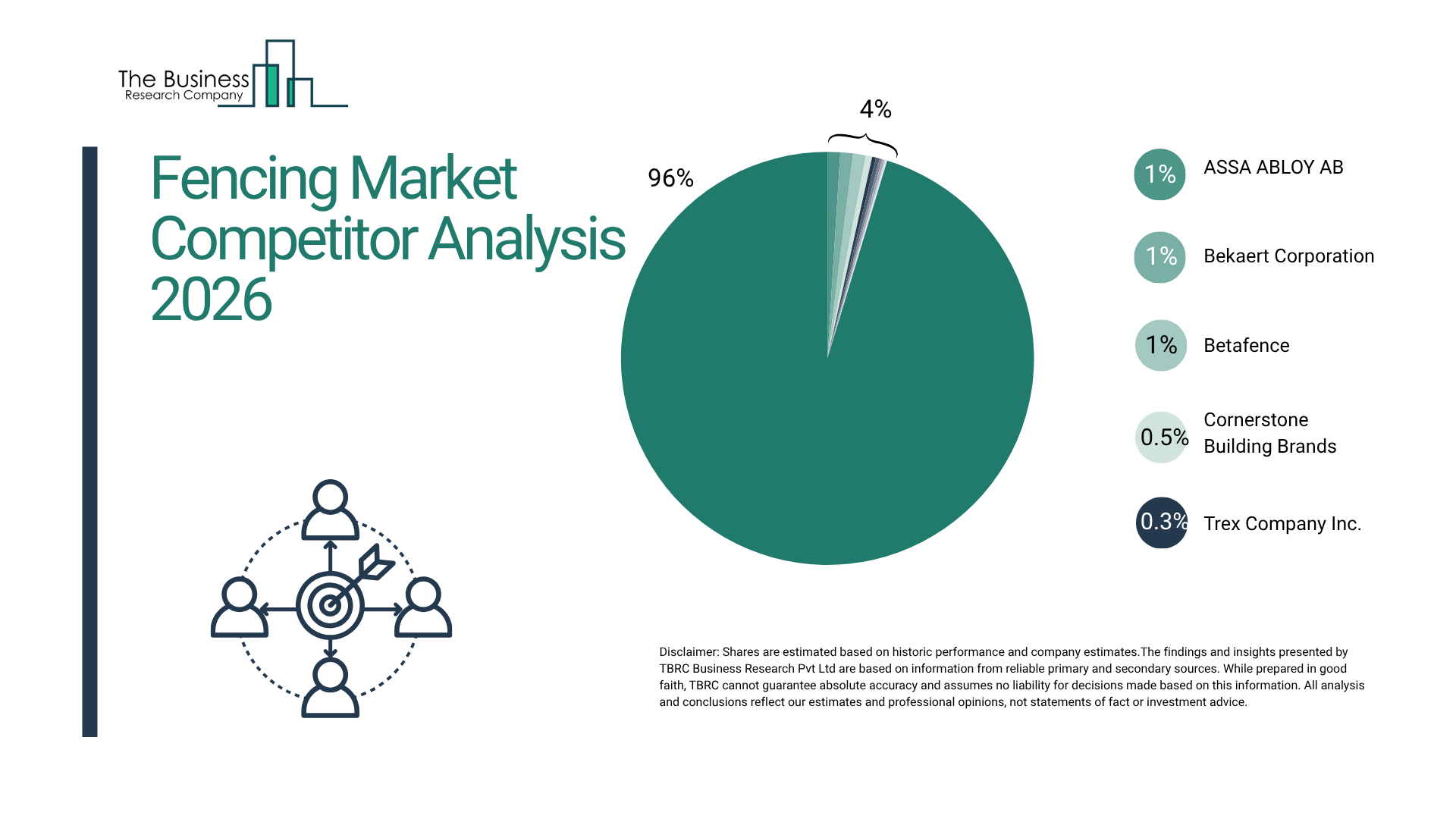
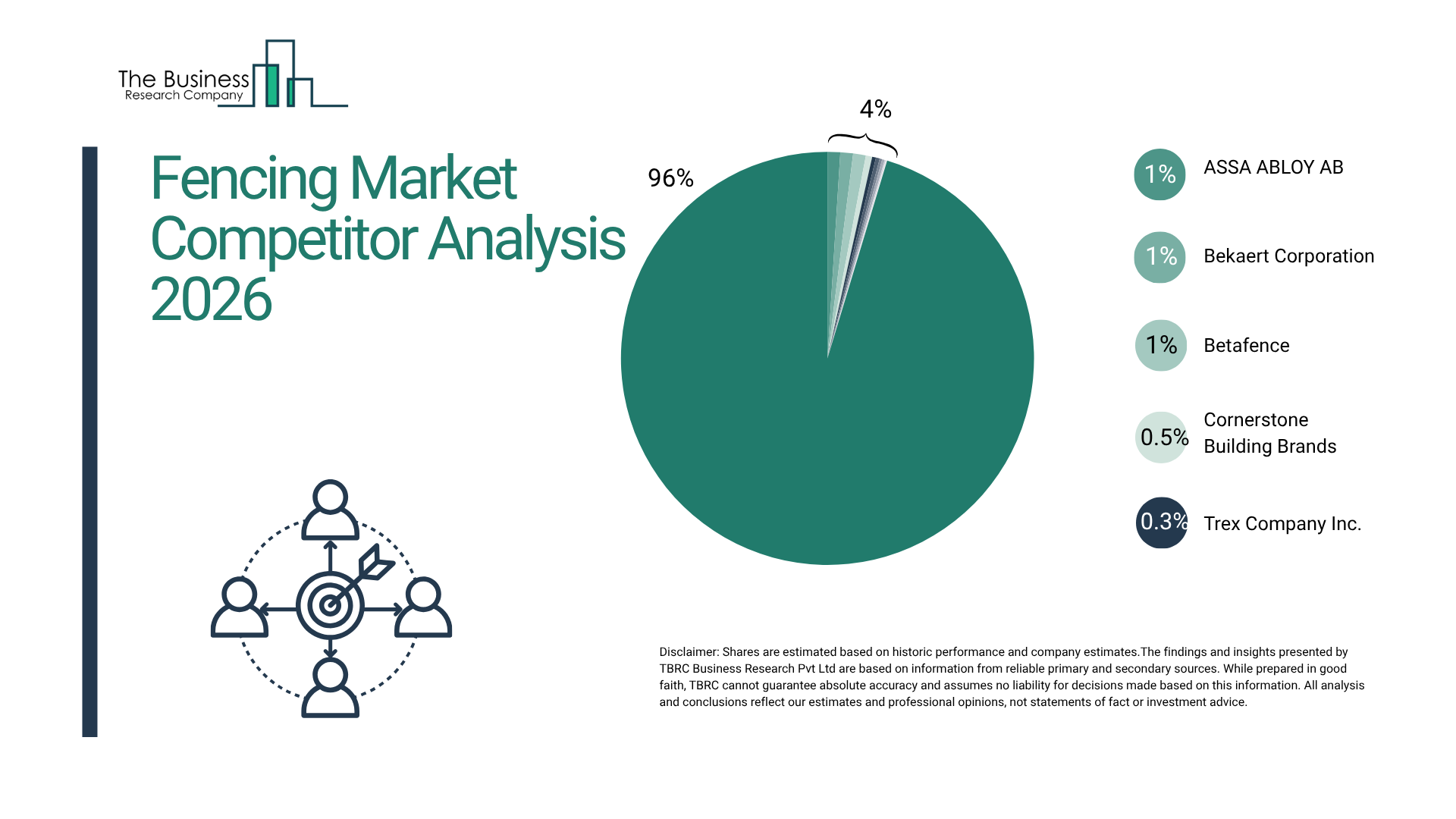
ASSA ABLOY AB emerged as the global leader in fencing-related sales in 2024, commanding a 1% share of the market. Their portfolio of perimeter security and access solutions spans fencing systems, gates, access control, and perimeter protection products that serve residential, commercial, industrial, and governmental sectors. Other prominent players include Bekaert Corporation, Betafence, Cornerstone Building Brands, Trex Company Inc., Universal Forest Products Inc., and several others.
The fencing market remains highly fragmented due to relatively low barriers to entry at the regional manufacturing and installation levels. With diverse end-user requirements, local distribution channels, material-specific products, and varying regulations, smaller firms hold many niche positions. However, market leaders maintain competitive advantages through extensive product ranges, established dealer networks, geographic reach, and strong project execution capabilities. As demand grows for advanced perimeter protection, sustainable materials, automated access, and custom fencing solutions, ongoing product development, channel expansion, and acquisition strategies will further cement their positions.
Leading Companies by Market Share in 2024
The top 10 companies account for only about 4% of the fencing market revenue in 2024, underscoring fragmentation. The leading firms are:
1. ASSA ABLOY AB – 1%
2. Bekaert Corporation – 1%
3. Betafence – 1%
4. Cornerstone Building Brands – 0.5%
5. Trex Company Inc. – 0.3%
6. Universal Forest Products Inc. – 0.3%
7. Long Fence Company Inc. – 0.2%
8. Fortress Building Products – 0.2%
9. Stephens Pipe & Steel LLC – 0.1%
10. Pexco LLC – 0.1%
Competitive Strategies Employed by Leading Market Players
Top companies differentiate themselves by integrating smart fencing systems with IoT-based perimeter monitoring, utilizing advanced composite materials for enhanced durability and weather resistance, offering automated gate solutions for secure access control, adopting sustainable manufacturing processes using recycled and eco-friendly products, and expanding their presence in high-security perimeter protection projects for critical infrastructure.
The Fencing Market Value Chain from Materials to End Users
The fencing industry’s value chain spans numerous raw material suppliers such as Nucor Corporation, Steel Dynamics Inc., ArcelorMittal, Gerdau S.A., and others in metals and timber, alongside distributors and wholesalers including Master Halco Inc., Fencing Supply Group, The Home Depot, Builders FirstSource Inc., and more. End users cover a wide range of sectors like retail giants Walmart Inc. and Amazon.com Inc., transportation companies Union Pacific Railroad and BNSF Railway, energy corporations such as Exxon Mobil and Chevron, defense firms like Lockheed Martin, and public infrastructure operators.
Where the Fencing Market Will Add Its Largest Value by 2030
Plastic, metal, wood and composite, and concrete fencing segments are poised to deliver the majority of growth value, collectively adding over $11 billion by 2030. Metal fencing alone is expected to grow by $5 billion, wood and composite by $3 billion, plastic by $2 billion, and concrete by $1 billion between 2025 and 2030. This growth is driven by modernization efforts, the need for long-lasting boundary protection, demand for aesthetically pleasing fencing in new residential communities, and innovations in material engineering that enhance durability, sustainability, and installation efficiency. Overall, the market highlights a growing emphasis on security, operational reliability, and cost-effective lifecycle management.
New strategic additions in our 2026 market reports include market attractiveness scoring and analysis, total addressable market (TAM) analysis, company scoring matrix graphics and tables, Excel-based forecasting dashboards, market hotspots infographics, key technologies and future trend analysis, along with updated graphics and tables.
Learn More About The Business Research Company
The Business Research Company (www.thebusinessresearchcompany.com) is a leading market intelligence firm renowned for its expertise in company, market, and consumer research. We have published over 30,000+ reports across 27 industries and 60+ geographies. Our research is powered by 1,500,000 datasets, extensive secondary research, and exclusive insights from interviews with industry leaders.
We provide continuous and custom research services, offering a range of specialized packages tailored to your needs, including Market Entry Research Package, Competitor Tracking Package, Supplier & Distributor Package and much more.
Disclaimer: Please note that the findings, conclusions and recommendations that TBRC Business Research Pvt Ltd delivers are based on information gathered in good faith from both primary and secondary sources, whose accuracy we are not always in a position to guarantee. As such TBRC Business Research Pvt Ltd can accept no liability whatever for actions taken based on any information that may subsequently prove to be incorrect. Analysis and findings included in TBRC reports and presentations are our estimates, opinions and are not intended as statements of fact or investment guidance.
Contact Us:
The Business Research Company
Americas +1 310-496-7795
Europe +44 7882 955267
Asia & Others +44 7882 955267 & +91 8897263534
Email: marketing@tbrc.info
Follow Us On:
LinkedIn: https://in.linkedin.com/company/the-business-research-company"
Oliver Guirdham
The Business Research Company
+44 7882 955267
info@tbrc.info
Visit us on social media:
LinkedIn
Facebook
X
Legal Disclaimer:
EIN Presswire provides this news content "as is" without warranty of any kind. We do not accept any responsibility or liability for the accuracy, content, images, videos, licenses, completeness, legality, or reliability of the information contained in this article. If you have any complaints or copyright issues related to this article, kindly contact the author above.
